Context Switching: Why It Drains Me More Than the Work Itself
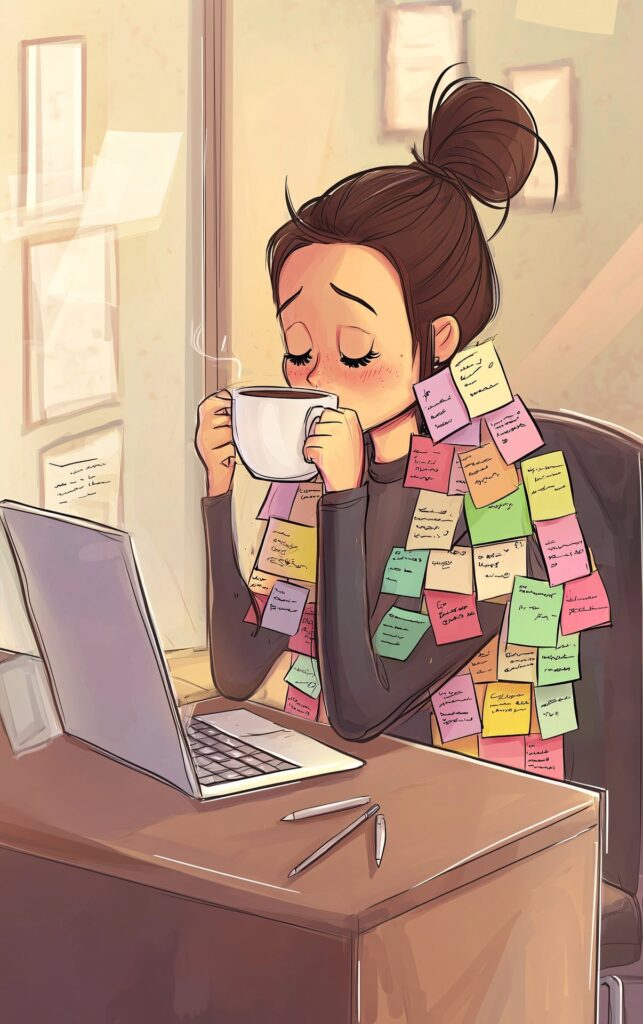
I used to assume that the most exhausting work would also be the most difficult work. If I spent hours writing something complicated, solving a technical problem, or researching a subject I did not understand well, it made sense that I would feel tired afterward. What confused me more were the days when none of the individual tasks seemed particularly demanding, yet I reached the end of the day feeling as if I had done something much harder. Those days often looked productive from the outside. I might write for a while, check something on my website, answer an email, look at analytics, fix a small technical issue, return to the article I was writing, remember an administrative task, deal with that, and then try to go back to where I started. I had completed plenty of small things, but I had also spent the entire day repeatedly changing what my brain was supposed to care about. Eventually I started paying more attention to context switching, because the switching itself seemed to be costing me more energy than many of the tasks.
Working alone makes this particularly easy to miss. There is no department boundary telling me when I have stopped being a writer and started doing technical support, marketing, research, administration, or planning. They are all simply “my work,” and because they happen on the same laptop, sometimes inside the same browser, they can look almost interchangeable. Mentally, they are not interchangeable at all. Writing requires me to hold an argument and a certain tone in my head. Looking at analytics pushes me toward numbers, comparison, and evaluation. Solving a WordPress problem makes me think in terms of settings, causes, and possible errors. An email may suddenly require me to remember a conversation from several days earlier. Each task asks for a different mental environment, and every time I switch, I have to abandon one environment and reconstruct another.
Context switching is different when every role belongs to me
Inside a larger company, work is usually divided to some degree by function. A person may still have a complicated job, but there are limits to the kinds of problems they are expected to solve during an ordinary afternoon. Working independently removes many of those limits. I can move from strategic decisions to formatting an image, from writing a long article to checking whether a tracking code is installed correctly, and from thinking about a future business idea to answering something that arrived in my inbox five minutes ago. None of these tasks necessarily deserves an entire day, so combining them seems efficient. The problem is that I tend to count only the visible minutes required to complete each task and ignore the mental transition around it.
If an email takes five minutes to answer, I instinctively think of it as a five-minute interruption. In reality, it may interrupt a train of thought that took much longer to build. I have to read the message, remember the relevant background, decide what I think, write the response, and then somehow return to the article or problem that occupied my attention before the message arrived. The reply may have taken five minutes, but returning to exactly the same level of concentration can take much longer. This is one of the reasons a day full of small tasks can feel strangely unproductive even when I technically finished many of them.
The difficulty is that context switching rarely looks dramatic while it is happening. There is no obvious moment when I can say, “I just lost twenty minutes of useful attention.” Instead, the loss appears gradually as slower thinking, repeated rereading, forgotten intentions, and the uncomfortable feeling that I have been busy for hours without getting deeply into anything. For a long time I blamed that feeling on poor concentration. I am less convinced now. Sometimes the problem is not that I cannot focus. It is that I keep asking myself to focus on a different thing before the previous one has properly left my head.
The hardest switch is often not between tasks, but between ways of thinking
Not all task changes affect me equally. Moving from one piece of writing to another can be relatively easy because the mental mode is similar. The same is true when I batch several administrative tasks. The more difficult switches are the ones that require a completely different way of thinking.
Writing is a good example. When I am properly immersed in an article, I am not just typing sentences. I am holding the structure of the argument, remembering what I have already said, noticing repetition, deciding what belongs in the next section, and trying to maintain the same voice throughout the piece. If I stop in the middle to check a technical setting on my website, the information I need for that new task has almost nothing to do with the information I was holding for the article. The writing context has to move aside so I can think about plugins, code, settings, or whatever else needs attention.
The technical task may only take ten minutes. When I return to the article, however, the cursor is still exactly where I left it while my mind is not. I reread the previous paragraph. Then I reread the section above it because I no longer remember where the argument was going. I may even scroll back to the beginning because the rhythm of the piece feels unfamiliar after the interruption. What looked like one small detour has created two transitions: one into the technical problem and another back into the writing.
This is probably why I sometimes feel more tired after a fragmented day than after several uninterrupted hours of difficult work. Deep work can be demanding, but at least the demand is consistent. Context switching repeatedly asks the brain to drop one set of priorities and activate another, and the accumulated cost is easy to underestimate because it is spread across the entire day.
My browser makes every other job look one click away
Working digitally makes this problem worse because almost everything I could possibly work on is physically close together. My website, email, analytics, notes, research, AI tools, documents, and various dashboards are separated by tabs rather than rooms. The distance between one role and another is often a single click.
That convenience is useful, but it also removes friction that might otherwise protect my attention. If I were writing on paper and needed to walk to another room to check analytics, I would probably ask whether I actually needed the information right now. In a browser, the question hardly occurs. I can check in a few seconds, so I do. A notification appears, so I look at it. I remember a setting I wanted to change, so I open another tab before I forget. Something I was waiting for crosses my mind, so I check whether it has changed.
Each individual action feels too small to matter, which is exactly why the pattern can continue for hours.
I have also noticed that open tabs create a strange form of invitation. A tab does not actively interrupt me, but it keeps a different task visible. I may be writing while seeing email, analytics, WordPress, and several unrelated pieces of research waiting nearby. Even when I do not click them immediately, part of me remembers that those other tasks exist. If I reach a difficult sentence or a moment of uncertainty, switching to something easier becomes almost effortless.
The result is that I can mistake accessibility for urgency. Something is easy to check, therefore I check it. Something is visible, therefore it feels unfinished. Something can be done now, therefore I start doing it now. None of those statements actually means the task deserves my attention at that moment.
Context switching can disguise itself as productivity
This is the part I find most deceptive. A fragmented day can produce a lot of visible activity.
I can clear messages, adjust settings, check several dashboards, make a few notes, change a page, save some research, and complete several small tasks. By the end of the day, there may be a long list of things I touched. That feels reassuring because movement is easy to measure.
The problem is that touching many things is not necessarily the same as moving the important things forward.
Some of my most valuable work is slow and visually unimpressive. Developing an argument for an article may take hours before there is anything finished to show. Thinking through a business decision can involve reading, comparing, discarding ideas, and sitting with uncertainty. Learning something difficult often produces very little immediate evidence that work happened. These activities are much easier to abandon than small tasks because the small tasks give me quicker completion signals.
When I am mentally tired or uncomfortable with a difficult problem, context switching can become a convenient escape without feeling like one. I am still working. I have not opened entertainment or walked away from the desk. I have simply chosen another legitimate task. That makes the behavior much harder to notice.
I do not think every switch is avoidance. Many are necessary. But I have become more suspicious of the moment when a difficult piece of work suddenly reminds me of five other useful things I could be doing. Sometimes those other tasks genuinely matter. Sometimes my brain is simply offering me an easier environment.
The unfinished task does not disappear when I switch away from it
Another reason switching is tiring is that the previous task does not always leave cleanly. If I stop while something is unresolved, part of it tends to remain active in the background.
I notice this most when I switch because I feel stuck. Maybe I cannot decide how to structure a section of an article, I do not know why something on the website is behaving strangely, or I am waiting for information before I can make a decision. I move to another task, but some part of my attention keeps returning to the unresolved one. I may technically be reading an email while thinking about the article. Then I return to the article while remembering that the email created another task.
After enough switching, I can end up carrying several unfinished mental threads at once.
This connects closely to why I have started documenting my work more carefully. If I need to stop, leaving a short note about what I was trying to solve, what I already checked, or what I intended to do next makes the switch much cleaner. The task has somewhere to wait other than my memory. I do not need to keep rehearsing it mentally because I am afraid I will lose the context.
The same principle applies to asynchronous work. If something genuinely cannot move forward right now, I want it to have a clear state: waiting for a reply, checking again tomorrow, returning after another task is finished. An undefined pause is much more mentally expensive than a defined one because I keep having to decide whether I should return to it.
I have stopped trying to solve context switching with perfect discipline
For a while, I thought the obvious answer was to become much stricter. I imagined ideal days divided into clean blocks where I would write for several hours, check email at a fixed time, batch administrative tasks, and never allow a stray tab or notification to interrupt anything important.
That works better in theory than in my actual life.
Working independently means unexpected things do appear. Some emails matter. Websites break. A small task occasionally needs to be handled immediately because ignoring it would create a bigger problem later. There are also days when my concentration is simply better suited to one type of work than another. I do not want a system that treats every deviation as failure.
What has helped more is reducing unnecessary switches rather than trying to eliminate all of them.
If I am already doing administrative work, I try to stay in that mode long enough to deal with several similar things together. If I am writing, I am more likely to make a quick note about something I remember instead of immediately opening the relevant tab. If a question can wait until I reach a natural stopping point, I let it wait. I also try to notice when I am switching because the current task genuinely requires it and when I am switching simply because another task suddenly feels easier.
None of this creates perfectly focused days. What it does is reduce the number of times I need to rebuild a mental environment that I had only just created.
I now think in terms of roles, not just tasks
One useful change has been recognizing that tasks belong to different mental roles.
Writing an article and editing another article may be different tasks, but they belong to a similar mode. Checking invoices, replying to routine messages, and updating records also share a kind of administrative mode. Technical troubleshooting is another. Research is another. Planning is another.
When I group work this way, I understand why two thirty-minute tasks can have very different effects depending on where they sit in the day. If they require the same mental mode, moving between them may be almost effortless. If they require completely different modes, the transition can be surprisingly expensive.
This has changed the way I think about productivity. I used to ask whether I had enough time to fit a task into an empty space. Now I am more likely to ask whether it belongs with what I am already doing.
A fifteen-minute task may technically fit between two writing sessions, but if it requires me to open several dashboards, evaluate numbers, and make a decision, the real cost may be much larger than fifteen minutes. Sometimes it is better to leave the empty space empty or use it for something that does not require such a dramatic shift.
That also means I have become less interested in filling every part of the day. A schedule that appears less efficient on paper can produce better work if it protects the continuity of attention.
The goal is not to stay focused on one thing forever
I still switch contexts constantly. Anyone running independent work probably has to. The goal for me is not to build an artificial version of a job where I spend eight uninterrupted hours doing one type of work.
What I want is to stop treating every switch as free.
The five-minute email has a cost beyond five minutes. The quick analytics check can change the emotional direction of the next hour. The technical problem I decide to “just fix now” may replace an entire train of thought. The new idea I immediately research may leave the original project waiting for me to reconstruct it later.
Once I started seeing those transitions as part of the workload, some of my own energy patterns made more sense. The days that leave me most depleted are not always the days when I worked hardest. They are often the days when I asked my attention to move between too many different worlds.
That has made me more protective of continuity. If I am already inside a difficult piece of work, I try to stay there a little longer. If something else occurs to me, I capture it rather than immediately following it. If I need to stop, I leave enough context to make returning easier. When several tasks belong to the same mental role, I try to let them share the same part of the day.
None of these habits is particularly dramatic, which is probably why they work better for me than elaborate productivity systems. I am not trying to become a person who never gets distracted. I am trying to reduce the amount of energy I spend repeatedly becoming a different kind of worker.
For someone who works alone, that may be one of the least visible parts of the job. I may only be one person, but on an ordinary day I can still move through half a dozen roles. Context switching is the cost of moving between them, and I have learned that the cost is real even when every individual task looks small.