When I think about how to stay focused working from home, I do not think the answer is becoming better at ignoring everything around me. Home contains too many ordinary signals: food, laundry, messages, deliveries, a comfortable place to sit, small chores I suddenly notice, and all the personal things that exist a few steps away from work. I have had better results when I change the environment and the transitions around my work instead of expecting concentration to win every argument by force.
This is one of the things I like about working at home and one of the things that makes it complicated. I have more control over the space, which means I can make it comfortable. I also have more access to everything that is not work. The same freedom that makes the day pleasant can make attention feel unusually negotiable.
How to Stay Focused Working From Home Without Relying on Willpower
The most useful shift for me has been to stop treating distraction as a character flaw. If something repeatedly pulls my attention away, I try to make the pull weaker rather than repeatedly proving that I can resist it.
That might mean putting my phone farther away, closing unrelated tabs, moving a visible reminder out of the room, or deciding in advance what I am going to work on before I sit down. None of these changes are dramatic. They simply reduce the number of invitations my attention receives while I am trying to stay with one task.
I have written about working from home as a collection of small environmental choices, and focus works the same way for me. The room does not need to be perfect. It needs to make the intended behavior slightly easier.
I Need a Clear Beginning More Than a Perfect Schedule
At home, work can begin at any time, which sometimes means it begins vaguely. I check one message, open a document, make coffee, answer something else, and only later realize that I never really chose what the first work block was supposed to be.
A clearer beginning helps. I like knowing the first task before I sit down. It can be small, but it needs to be specific enough that I can start without negotiating with myself.
That first transition matters because attention builds momentum. If the beginning of the day is already fragmented, I am more likely to continue switching between things. If I get into one task early, it is easier to protect that mode for a while.
Visible Distractions Are More Powerful Than I Expect
I underestimate how much visual information affects me. A phone on the desk can be silent and still remind me that messages exist. An unrelated document can remind me of another project. A pile of things I need to put away can become a background list of unfinished decisions.
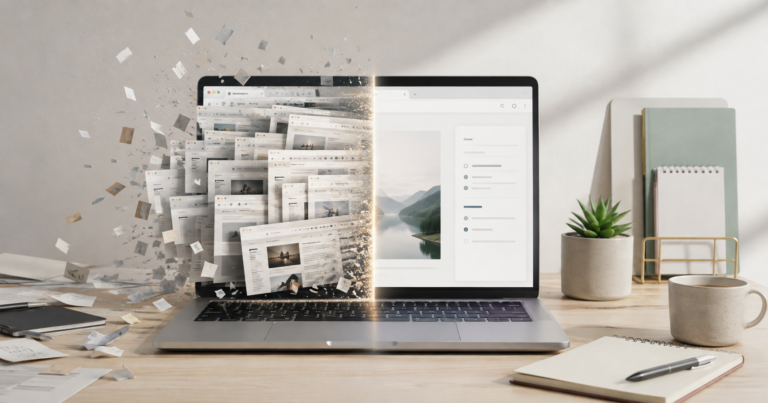
I do not need an empty room, but I prefer the area directly around me to support the current task. This is similar to what I notice with context switching on a screen. I can switch attention without physically doing anything. Sometimes simply seeing the next possible task is enough to loosen my concentration on the current one.
Reducing visual noise is not about making the room beautiful. It is about giving fewer things the chance to ask for attention.
I Match Focused Work to the Energy I Actually Have
Some distraction is really fatigue wearing a different name. When my energy is low, almost anything becomes more interesting than a demanding task. I can respond by fighting myself for an hour, or I can notice that the work and my current capacity are mismatched.
The way I think about energy management has made focus more realistic. I try to use stronger periods for work that needs sustained thinking and leave easier administrative tasks for times when my attention is naturally more fragmented.
This does not always fit perfectly. Deadlines exist, and some days do not cooperate. But when I have control over the sequence, I would rather work with my concentration than spend the whole day proving that I can work against it.
Breaks Work Better When They Have Edges
Working from home makes breaks easy to start and strangely hard to define. I can stand up for water and return forty minutes later after doing three unrelated things. The problem is not that I took a break. The problem is that the break did not have a clear boundary.
I find short breaks more restorative when I know what they are for. I might make a drink, stretch, step outside briefly, or eat something. When the break becomes a general invitation to check everything, it tends to fragment the next work block as well.
I do not use a rigid timer for every minute, but I like some sense that I am leaving work temporarily rather than dissolving the workday into home life.
I Protect One Task at a Time
A large part of staying focused at home is deciding what I am not doing right now. If I am writing, I am not also checking analytics. If I am doing research, I am not reorganizing files. If I am handling administrative work, I am not trying to keep a creative idea active in the background.
This sounds obvious, but independent work makes it easy to hold several roles at once because every role belongs to me. There is no external boundary telling me that the meeting ended and the writing block began. I have to create those boundaries myself.
I focus better when I make the current role temporarily exclusive. The other work still exists. It just does not get to sit in the foreground at the same time.
Focus at Home Is Something I Design Around
I still get distracted. I still have days when concentration is inconsistent and ordinary tasks take longer than I expected. Working from home has not turned attention into something I can control perfectly.
What has changed is that I no longer expect perfect control. When I think about how to stay focused working from home, I look at the conditions around the work: what is visible, what I chose to start with, how much energy I have, what is competing for attention, and whether the current task is clear enough to enter.
Those adjustments are less dramatic than a perfect productivity routine, but they are more useful to me. Focus becomes something the environment can support rather than a test I have to pass all day.